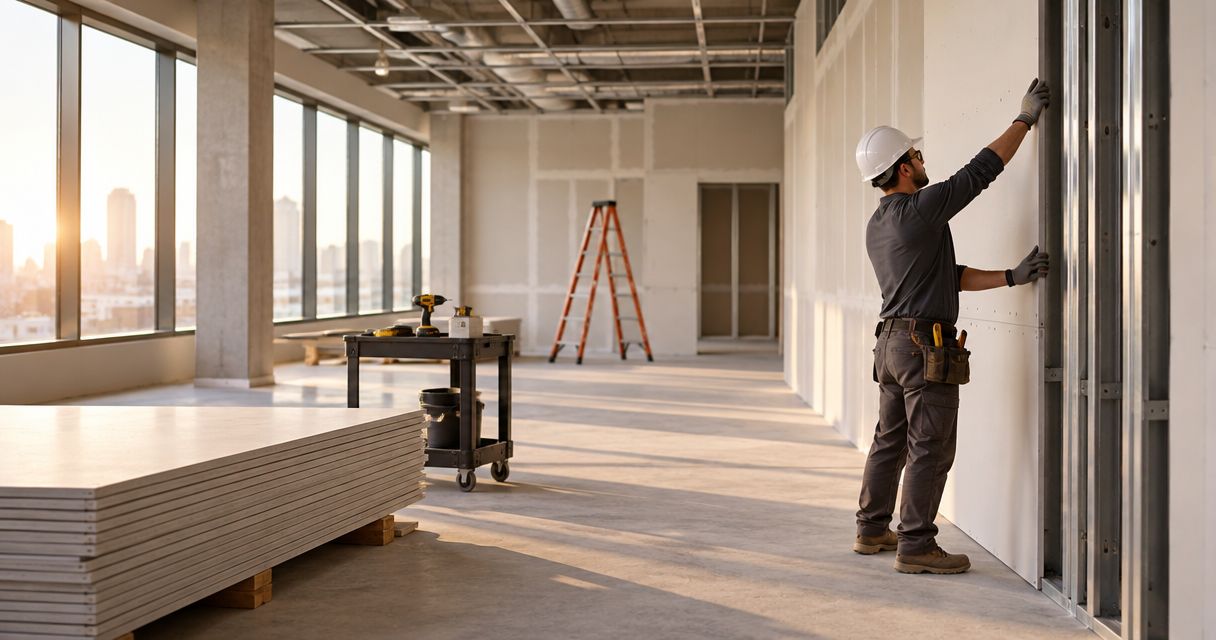
Commercial drywall installation takes as long as the approved scope, work-area releases, finishing requirements, and site conditions require; there is no reliable project-wide duration without those details. Hanging board is only part of the schedule: inspections, joint-compound drying, sanding, and acceptance also control the handoff to painting. For a usable completion date, request an area-by-area schedule that separates installation, finishing, and release to the next trade.
- Commercial drywall installation needs an area-by-area schedule, not a board-hanging estimate presented as total completion.
- Level 5 finishing adds a skim-coat operation beyond Level 4; specify the finish before scheduling.
- Inspections, drying conditions, access, and trade handoffs belong in the baseline schedule.
- Northeasterndrywall serves general contractors and developers seeking drywall subcontracting in Binghamton and across Upstate New York.
How long does commercial drywall installation take?
The defensible duration is the time needed to move each defined area from ready-for-board conditions through the specified finish and accepted turnover. A crew's hanging duration does not answer that question on its own.
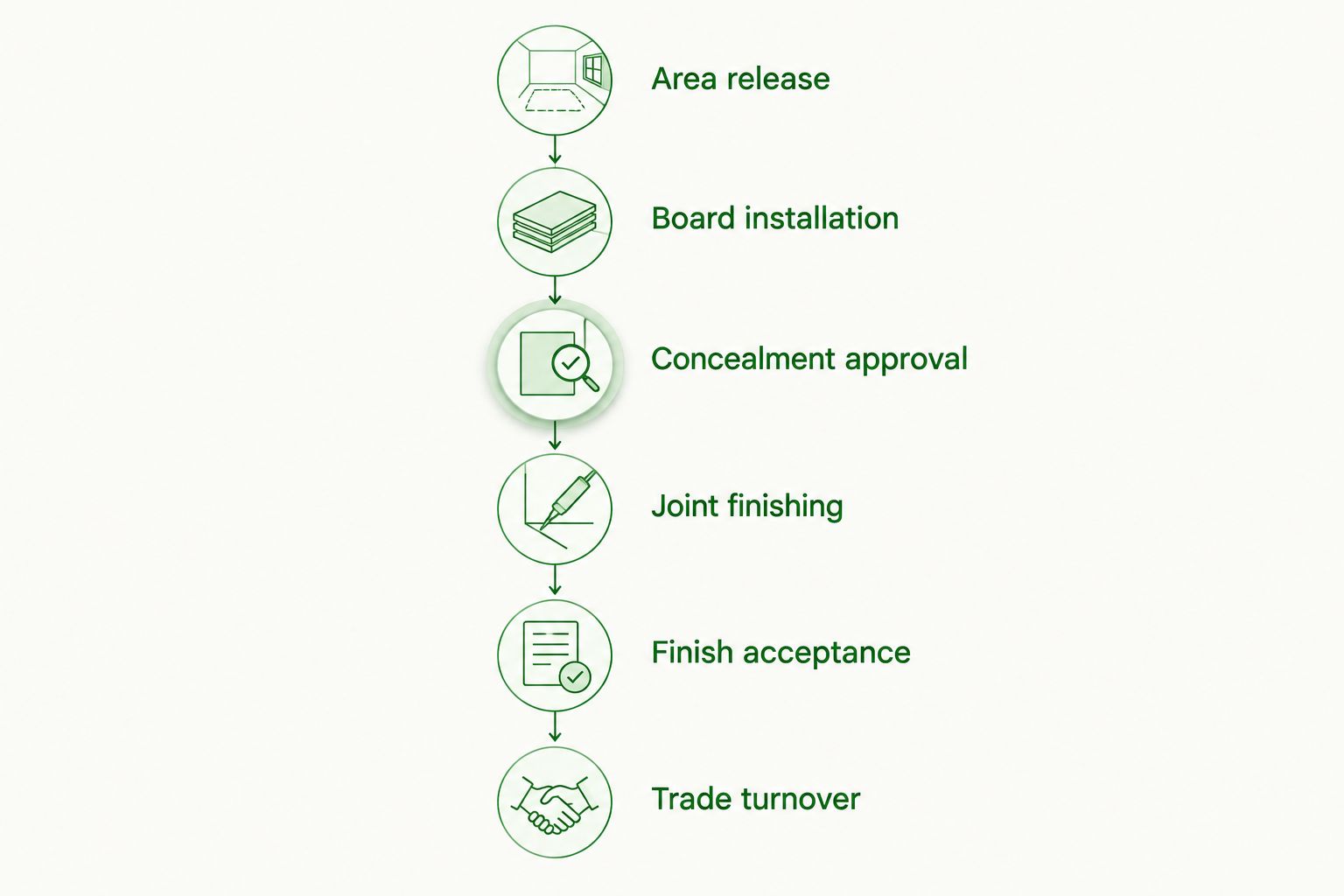
For a 2026 bid, ask the subcontractor to identify the sequence below. When evaluating Northeasterndrywall for commercial drywall installation, use the same scope and schedule questions you send to every bidder.
- Area release. Confirm framing, concealed services, required inspections, access, and material staging before releasing the area.
- Board installation. Identify board types, layers, wall heights, ceilings, openings, and access constraints.
- Concealment approval. Identify inspection or documentation hold points before covering work that must remain visible.
- Joint finishing. Schedule the specified tape, compound, drying, and sanding operations.
- Finish acceptance. Check completed surfaces against the specified finish and resolve deficiencies.
- Trade turnover. Release accepted areas to the next trade with remaining restrictions recorded.
Ask for dates against these activities, not a single completion bar. That makes a delayed release distinguishable from a finishing delay and gives the GC a clear coordination decision.
Why this matters
A drywall completion date becomes a commitment for painters, ceiling installers, flooring crews, and other finish trades. If the date represents board installation rather than accepted finishing, the downstream schedule starts from the wrong milestone.
For Binghamton and Southern Tier projects, put the actual building conditions and work restrictions into the bid package. A shared assumption is useful; an unstated assumption becomes a coordination problem when crews arrive.
Schedule the deliverable the next trade needs, not just the activity the drywall crew performs. A painted-wall turnover requires a different acceptance point from a wall ready for joint treatment.
Level 4 finish: define the handoff to painting
Level 4 finish includes joint and fastener treatment without the full-surface skim coat associated with Level 5. Specify it by area and coordinate it with the intended decoration and lighting conditions.
Level 4 avoids the additional full-surface skim-coat operation, but it is not an interchangeable substitute wherever Level 5 is specified. Confirm the design requirement before treating a finish change as a schedule-saving measure.
The bid should state whether primer, touch-up after priming, and final paint preparation belong to the drywall scope, painting scope, or a coordinated handoff. Otherwise, separate trades can each consider their portion complete while the surface remains unaccepted.
Level 5 finish: include the skim-coat operation
Level 5 adds a thin skim coat across the surface beyond Level 4 joint treatment. That additional operation belongs in the work sequence, along with the conditions needed for application, drying, and subsequent preparation.
The benefit is a more uniform surface for demanding decoration and lighting conditions. The limitation is additional finishing work; specifying Level 5 does not remove the need to assess framing alignment, workmanship, or lighting at acceptance.
| Finish option | Best for | Scheduling implication | Limitation |
|---|---|---|---|
| Level 4 | Areas where the design and decoration requirements call for Level 4 | Schedule joint treatment, drying, sanding, and acceptance | Does not include a full-surface skim coat |
| Level 5 | Areas where the design and decoration requirements call for Level 5 | Include the additional skim-coat operation and subsequent preparation | Adds work and still requires agreed acceptance conditions |
Keep Level 4 and Level 5 areas separate in the scope and schedule. A blanket finish assumption makes it harder to compare bids and identify what a proposed acceleration actually changes.
Why commercial drywall installation duration varies
These factors change the work required or the time available to perform it. Carry them into the 2026 baseline schedule rather than leaving them in meeting notes.
- Assembly requirements. Board types, layer counts, rated details, and wall heights affect installation scope. A floor-area total does not describe those differences.
- Work-area readiness. Incomplete framing, unresolved backing, concealed-service work, or required inspections prevent a clean release. Identify the responsible trade for each prerequisite.
- Finish requirements. Level 4 and Level 5 are different scopes. Confirm finish boundaries, decoration requirements, and the acceptance process before setting turnover dates.
- Environmental conditions. Temperature, humidity, and ventilation affect drying. Follow the selected materials' instructions rather than assuming every area supports the same finishing sequence.
- Access and continuity. Occupied areas, restricted work hours, lift access, staging, and fragmented releases change how crews move through the work. Record those constraints in the bid documents.
- Trade coordination. Insulation, inspection, ceilings, painting, and later penetrations create interfaces. Assign responsibility for readiness, protection, and repair instead of treating them as incidental work.
A schedule explanation should connect each constraint to an activity or release. A general statement that the project is complicated does not tell the GC what must happen next.
What should a commercial drywall schedule include?
A commercial drywall schedule should show identifiable areas, prerequisites, installation activities, finishing activities, and acceptance milestones. Each date needs a defined deliverable and an owner for the conditions supporting it.
Use this checklist when reviewing a subcontractor's proposed sequence:
- Area identification: Use room, floor, wing, or zone names that match the project documents.
- Ready-for-board conditions: Identify framing completion, concealed work, insulation where applicable, and required approvals.
- Installation boundaries: Distinguish walls, ceilings, shafts, soffits, and other assemblies rather than grouping unlike work together.
- Finish boundaries: Mark the specified finish and any areas requiring different treatment.
- Environmental responsibility: Assign temporary conditioning and ventilation responsibilities where the work requires them.
- Access assumptions: State work hours, delivery arrangements, staging space, and restrictions on equipment movement.
- Acceptance point: Define what the receiving trade will inspect and who signs off on the handoff.
- Repair responsibility: Separate correction of original work from damage or changes caused after turnover.
For a 2026 bid comparison, send the same checklist to all bidders. A shorter duration is not an equivalent proposal if it assumes unrestricted access while another bidder has included phased, occupied work.
Request a revised sequence when the assumptions change. Adding a note to the meeting minutes does not automatically update a subcontractor's planned workflow or the next trade's mobilization.
Can you speed up commercial drywall installation?
You can shorten avoidable delays by releasing complete work areas, resolving details early, and coordinating uninterrupted access. Adding labor alone does not remove inspection holds, drying requirements, or incomplete predecessor work.
Start acceleration discussions with the constraint, not the headcount. Ask whether the limiting issue is available workfront, access, material movement, finishing conditions, or trade interference.
A useful acceleration review follows this sequence:
- Identify the blocked activity. Name the affected area and the missing prerequisite.
- Confirm available work. Establish whether another complete area is ready without creating unnecessary remobilization.
- Review the proposed change. Check what added staffing, changed shifts, or revised phasing would require from the GC and other trades.
- Protect acceptance criteria. Keep the specified assembly, finish, inspections, and material instructions unchanged unless a formal revision authorizes otherwise.
- Update downstream dates. Obtain agreement from the receiving trade rather than moving only the drywall completion milestone.
This approach separates productive acceleration from crowding more people into an area that cannot support the work. Document any changed scope and schedule assumptions before directing the revised sequence.
How should you compare drywall bids for schedule reliability?
Compare the assumptions behind the completion date before comparing the date itself. Ask each bidder to explain the work included, the release conditions required, and the handoff being promised.
A schedule review should answer practical questions:
- Does the proposed duration include finishing, or only hanging?
- Are insulation and required concealment inspections accounted for?
- Does the bidder assume continuous access or phased releases?
- Who provides the environmental conditions required for finishing?
- Are painting and acoustical ceiling interfaces identified?
- How are changes, later penetrations, and post-turnover repairs handled?
A detailed sequence is more useful than an unsupported promise of an earlier finish. The sequence lets you test whether the proposed dates fit the rest of the job.
Northeasterndrywall provides drywall, insulation, acoustical ceiling, and painting subcontracting for residential and commercial projects. For commercial drywall installation inquiries in Binghamton, the Southern Tier, and wider Upstate New York, identify the requested scopes separately; the service list alone does not establish project-specific capacity, sequencing, or a completion commitment.
What should you send with a drywall bid request?
Send the drawings, specifications, scope boundaries, project location, and required milestone dates. Include the current drawing revisions and describe any occupied-area or phased-access restrictions.
For a 2026 bid request, distinguish the bid deadline from the required mobilization and turnover dates. Those dates serve different purposes, and a subcontractor needs all of them to evaluate the request.
Include known assembly requirements, finish levels, insulation interfaces, ceiling details, and painting boundaries. Ask bidders to identify exclusions and schedule assumptions explicitly rather than interpreting silence as inclusion.
If the design is still changing, identify the documents that establish the bid basis. A schedule tied to an undefined scope is not ready to become a subcontract commitment.
FAQ
How long does commercial drywall installation take from start to finish?
Commercial drywall installation requires a project-specific duration covering area release, board installation, finishing, and accepted turnover. Request those activities separately so a hanging estimate is not mistaken for the complete schedule.
Does drywall finishing take longer than hanging?
The relative duration depends on the assembly, specified finish, site conditions, and work sequence. Compare separate installation and finishing activities rather than assuming either one controls every project.
Does Level 5 drywall finish add time?
Level 5 adds a full-surface skim-coat operation beyond Level 4, so that work must appear in the schedule. The effect on overall completion depends on area sequencing and the conditions required for finishing.
Can painting start as soon as drywall is hung?
Painting should follow the specified surface preparation and accepted drywall finish, not board installation alone. Confirm drying, sanding, primer responsibilities, and the handoff criteria before releasing the area.
Will adding more drywall installers finish the project sooner?
Additional installers do not remove inspection holds, incomplete predecessor work, or finishing constraints. Confirm that complete work areas, access, and material movement can support the proposed staffing change.
What should I ask Northeasterndrywall about my project schedule?
Ask Northeasterndrywall to review the project location, drawings, requested scopes, finish requirements, area releases, and required turnover dates. Obtain a project-specific sequence and written assumptions before treating a proposed date as a commitment.
One last thing
A finished wall can still be an unfinished coordination item if another trade must reopen it. Before closing an area, confirm concealed work and required inspections, then record the release.
For your next 2026 schedule review, ask one question: What exactly must be true before this area is accepted and released? That answer turns a completion date into a usable handoff.