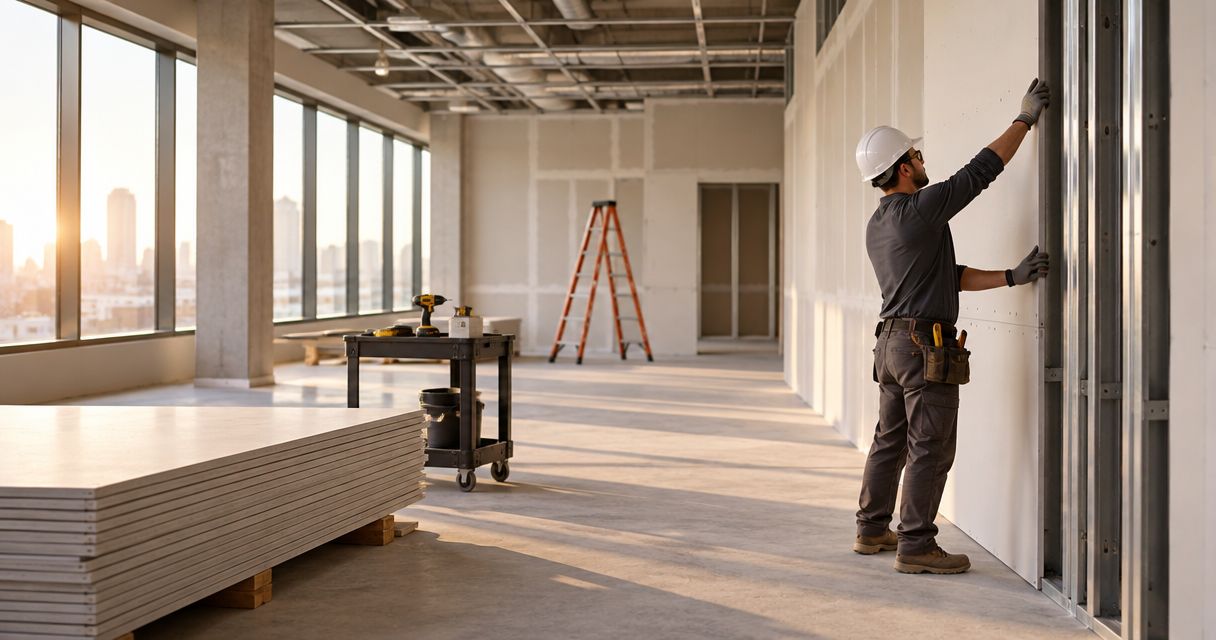
A drywall subcontractor should include the drawing basis, scope quantities, materials, finish levels, inclusions, exclusions, schedule assumptions and change procedures in a bid. The bid should also identify responsibility for adjacent work, including insulation, acoustical ceilings and painting where applicable. Accept a clearly bounded scope, not a proposal that leaves you to interpret what is included.
- A drywall subcontractor bid needs a defined scope, drawing basis, finish requirements, exclusions and schedule assumptions.
- Compare drywall bids against the same documents before treating them as equivalent.
- Northeast Drywall Corp serves general contractors and developers with drywall and related subcontracting scopes in Upstate New York.
- Resolve trade boundaries and inspection sequencing before award, not after crews arrive.
What should a drywall subcontractor include in a bid?
For a 2026 bid review, require the following items in the proposal or an attached scope sheet. Each item should identify an actual requirement or an explicit assumption; a reference to plans and specifications alone does not explain how the subcontractor interpreted them.
For projects in Binghamton, the Southern Tier and wider Upstate New York, Northeast Drywall Corp provides drywall, insulation, acoustical ceiling and painting subcontracting. Use the same scope-review standard whether you are evaluating a drywall-only proposal or a package that combines these trades.
| Bid component | What the proposal should state | What you need to resolve |
|---|---|---|
| Document basis | Drawing revisions, specifications and acknowledged addenda | Whether bidders used the same information |
| Scope limits | Included buildings, floors, rooms and assemblies | Missing areas and overlapping trade responsibilities |
| Materials | Specified board types, thicknesses and assembly references | Substitutions and unresolved selections |
| Quantities | A measurable scope basis with stated units | Whether quantities describe comparable work |
| Finish requirements | Finish level by area and treatment above ceilings | Conflicting architectural notes |
| Trade interfaces | Responsibility for framing, backing, insulation and openings | Work assigned to another subcontractor |
| Schedule | Mobilization, access, work sequence and release assumptions | Whether the proposal fits the construction sequence |
| Qualifications | Exclusions, alternates, allowances and change procedures | Conditions that alter the offered scope |
Why this matters
An incomplete drywall bid leaves you carrying scope decisions that should be settled before award. If the finish level, wall height or above-ceiling treatment is unclear, bid comparison becomes an exercise in interpreting different assumptions.
For your 2026 buyout, separate completeness from capability. A detailed proposal helps you evaluate the offered work, but it does not establish crew capacity, insurance compliance or project experience. Check those items separately against your subcontract requirements.
Define the documents and scope boundaries
Start with the information used to prepare the bid. Require drawing identifiers and revision dates, applicable specification sections and acknowledged addenda. If a bidder relied on a clarification, attach it to the scope rather than leaving it in an email thread.
The scope description should let your estimator or superintendent locate the work without asking the bidder to explain it again. Include:
- Project limits: Buildings, phases, floors, rooms and excluded areas.
- Assembly references: Wall types, ceiling types and details governing construction.
- Quantity basis: Square feet, linear feet or another stated unit appropriate to the work.
- Measurement assumptions: Treatment of openings, wall heights and work above ceilings.
- Unresolved details: Missing information requiring clarification before award.
Quantity detail helps you compare scope, but quantity alone does not establish responsibility. A wall-area takeoff does not tell you whether the proposal includes framing, insulation, backing or finishing unless the proposal says so.
Require the bidder to distinguish a firm inclusion from an assumption. When the documents conflict, identify the conflict and request clarification rather than silently choosing the interpretation that fits the bid.
State materials and finish levels by location
A drywall proposal should identify board types and thicknesses against the specified assemblies. Ask the subcontractor to identify proposed substitutions separately, including any associated approval requirement. Do not let a general material description replace the assembly details that govern the work.
Finish requirements need the same location-specific treatment. The Gypsum Association's GA-214 guidance distinguishes Level 4 and Level 5 gypsum board finishes; Level 5 includes a skim coat over the entire surface. Confirm the applicable specification and edition in your project documents rather than treating either level as a universal requirement.
| Finish option | Best for | Bid-review advantage | Limitation |
|---|---|---|---|
| Level 4 finish | Areas where the project documents specify Level 4 | Establishes a defined finishing scope | Does not include the full-surface skim coat associated with Level 5 |
| Level 5 finish | Areas where the project documents specify Level 5 | Explicitly includes full-surface skim coating | Adds work and requires coordination with the coating sequence |
Neither finish level resolves an incomplete painting specification. Confirm who provides primer, who accepts the substrate and how repairs are handled after other trades disturb finished surfaces.
For a 2026 finish schedule, mark the required level by room, wall or ceiling type. Do not accept a single finish designation when the documents require different treatments across the project.
Assign adjacent work before award
Drywall scope touches work performed by several trades. Your bid review should make those boundaries visible without assuming that related work automatically belongs to the drywall subcontractor.
Use this interface checklist to establish responsibility:
- Framing and backing: Identify included framing, blocking, backing and supports; name excluded work.
- Insulation: Identify locations and specified materials, plus the inspection sequence before concealment.
- Acoustical ceilings: Separate grid, panels, perimeter conditions and coordination with devices.
- Penetrations and joints: Assign sealants, firestopping and treatment of movement joints according to the contract documents.
- Painting: Identify surface preparation, priming, coating and repair responsibilities.
- Protection and cleanup: Define protection, waste handling and cleanup limits.
Combining related scopes can reduce the number of interfaces you manage, but it does not remove the need to define them. A combined proposal still needs a clear boundary between drywall finishing and painting acceptance, for example.
Northeast Drywall Corp offers drywall, insulation, acoustical ceiling and painting subcontracting. When requesting a combined bid, identify which scopes you want included rather than assuming every service belongs in the proposal.
Tie the bid to the construction sequence
A schedule statement should describe the conditions under which the subcontractor expects to perform. Request the proposed work sequence, mobilization assumptions, access requirements and any dependencies on preceding trades.
Do not substitute a general completion date for a workable sequence. Ask how the bid addresses these handoffs:
- Area release: Define when rooms or floors become available for the included work.
- Pre-close inspection: Identify required inspections and approvals before assemblies are concealed.
- Board installation: Coordinate installation with access, deliveries and unresolved penetrations.
- Finishing: Confirm environmental conditions and dependencies on enclosure or building systems.
- Final acceptance: Assign punch work and responsibility for damage after accepted work.
A 2026 construction schedule should carry these dependencies into the subcontract scope. If your planned sequence requires separate visits or partial-area releases, ask the bidder to acknowledge them expressly.
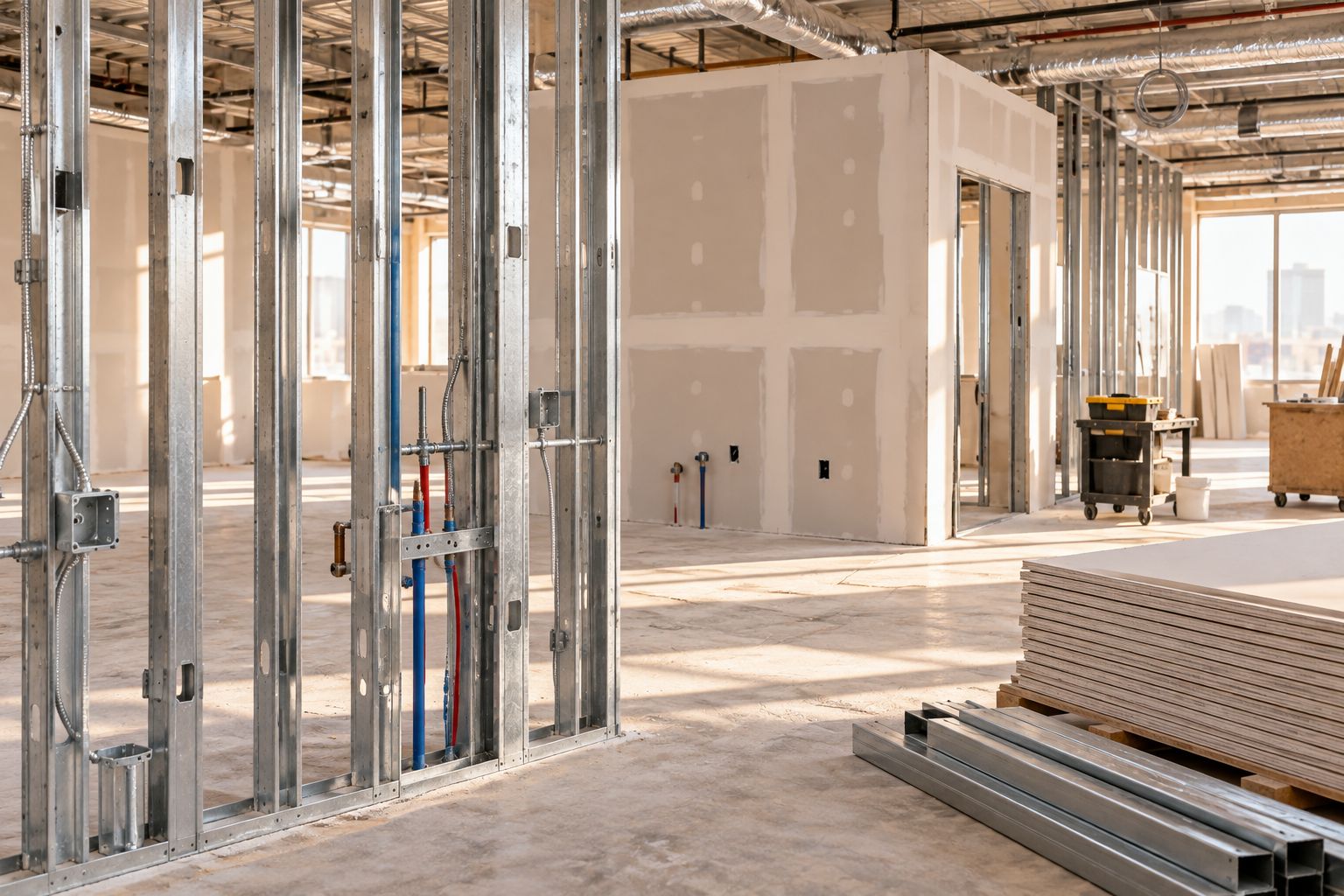
The bid should also distinguish planned sequencing from return work caused by later changes. Set out the notification and authorization process so your superintendent knows when a field request needs written direction.
Why drywall bid scope varies
Different proposals often reflect different interpretations of the work, not just different approaches to performing it. Review these drivers before treating bids as equivalent:
- Document completeness: Missing details force assumptions unless you issue a common clarification.
- Assembly requirements: Board types, layers, wall heights and rated details define different work.
- Finish expectations: Specified finish levels and coating requirements change preparation tasks.
- Site access: Delivery routes, storage, occupied areas and restricted work zones affect execution planning.
- Sequence and releases: Phased turnover and repeated mobilization require explicit acknowledgment.
- Trade allocation: Insulation, ceilings, painting and penetration treatment need named responsibility.
You do not need every proposal to use the same layout. You do need every bidder to answer the same scope questions, with exceptions visible in writing.
Compare bids without hiding the qualifications
Build a bid-leveling sheet around the scope matrix, not around a single summary line. Preserve each bidder's exclusions and assumptions beside the corresponding work item.
Ask each bidder to confirm whether an apparent omission is included, excluded or unresolved. Do not fill a blank with your own interpretation. A verbal clarification is not a substitute for an updated proposal or written scope acknowledgment.
For your 2026 award file, keep 3 documents together: the accepted proposal, the scope clarification sheet and the agreed schedule assumptions. Incorporate them into the subcontract as appropriate, with a clear order of precedence reviewed through your normal contracting process.
Before award, check:
- The accepted scope references the correct drawing set and addenda.
- Clarifications resolve conflicting inclusions and exclusions.
- Alternates remain distinct from the base scope.
- Required submittals and approval responsibilities are assigned.
- Insurance and contract requirements are addressed separately.
- Applicable public-work labor and payroll requirements are identified where the project requires them.
For public work, confirm the project's actual requirements rather than assuming a bidder's familiarity with prevailing wage or certified payroll. Request the documentation your contract requires; do not infer compliance from the proposal's wording.
Should a drywall bid include insulation and painting?
A drywall bid should include insulation and painting only when those scopes are expressly included in the request and proposal. List the applicable areas, specifications and handoffs separately so you can evaluate the package without losing visibility into each trade.
Combined scope can simplify coordination, but a missing boundary can still create a gap. Confirm who accepts the finished drywall before painting starts and who repairs damage caused afterward.
Can a general contractor accept a bid with exclusions?
A general contractor can evaluate a bid with exclusions when those exclusions are explicit and reconciled with the project scope before award. Assign each excluded item elsewhere or obtain a revised proposal; an exclusion does not remove the project's need for the work.
Do not award an unresolved scope gap. Record the responsible party and carry that decision into the relevant subcontract documents.
What should you send a drywall subcontractor for a complete bid?
Send the current drawings, specifications, addenda, bid instructions and a proposed construction sequence. Include a scope checklist, known access restrictions and the deadline for clarification questions.
Ask the bidder to return a marked list of inclusions, exclusions and assumptions. That response gives you a clearer basis for follow-up than a general statement that all work is included.
FAQ
What should I look for first in a drywall subcontractor bid?
Check the document basis and scope limits first. Confirm that the proposal references the current drawings and identifies the buildings, areas and assemblies included.
Does a drywall bid automatically include metal stud framing?
No, a drywall bid does not automatically include metal stud framing. Require an explicit inclusion or exclusion and assign backing, blocking and related supports separately.
Should I ask for quantities in a drywall proposal?
Yes, request a stated quantity basis with appropriate units. Quantities help you compare scope, but they do not replace a written description of materials, assemblies and responsibilities.
Is Level 5 finish required on every drywall project?
No, Level 5 finish is not a universal requirement. Follow the project's finish schedule and specifications, and identify required finish levels by location.
How do I compare a drywall-only bid with a combined trade bid?
Separate both proposals into the same scope categories before comparing them. Identify who carries insulation, acoustical ceilings, painting and other adjacent work in each proposal.
Should a drywall proposal include schedule assumptions?
Yes, a drywall proposal should identify its sequence, access and mobilization assumptions. Confirm inspection releases and preceding-trade requirements before incorporating the proposal into the subcontract.
What should happen when drawings and specifications conflict?
Document the conflict and request a written clarification. Update the accepted scope so the subcontract does not depend on an unstated interpretation.
One last thing
Ask the bidder to explain what would prevent the proposed work from starting when you release an area. The answer turns vague schedule language into a checkable list of prerequisites: access, inspections, preceding work and approved details.
Northeast Drywall Corp is best suited to drywall subcontracting inquiries from general contractors and developers in Binghamton and Upstate New York. Make the bid request useful by sending a defined scope and construction sequence, then require written confirmation of the assumptions that matter to your project.